Water Softeners and Water Purification in Durham Region: Do You Actually Need One?
What Is Hard Water and Why Does It Matter?
When we talk about "hard water," we are referring to municipal or well water that contains elevated levels of dissolved minerals—primarily calcium and magnesium. As rain water filters through soil, limestone, and chalk deposits, it naturally absorbs these minerals before entering municipal intake systems or underground aquifers.
While these minerals are completely safe to drink and do not pose a health risk, hard water can create significant friction in your everyday home routine. Calcium and magnesium don't stay dissolved once water is heated or evaporated; instead, they separate from the liquid and form a crusty, chalky residue known as scale (calcium carbonate). Over time, this scale buildup accumulates inside your pipes, fixtures, and expensive home appliances.
How Hard Is the Water in Durham Region?
If you've ever caught yourself asking, "Does Whitby have hard water?" or wondered why your fixtures in Oshawa or Ajax constantly collect white residue, the short answer is yes.
Municipalities across Durham Region—including Whitby, Oshawa, Ajax, Pickering, and Clarington—draw their water supply primarily from Lake Ontario. While municipal water treatment facilities do an incredible job of purifying water for safe consumption, standard municipal treatment processes do not remove dissolved mineral content.
Water hardness is measured in either parts per million (ppm) or grains per gallon (gpg):
- 0 to 60 ppm (0–3.5 gpg): Soft
- 61 to 120 ppm (3.5–7 gpg): Moderately Hard
- 121 to 180 ppm (7–10.5 gpg): Hard
- 180+ ppm (10.5+ gpg): Very Hard
Across Durham Region, municipal water commonly tests in the moderately hard to hard range (often ranging between 120 to 180+ ppm depending on your exact municipality and seasonal shifts). For households relying on private wells in rural parts of Durham, hardness levels can easily exceed 200+ ppm.
What Hard Water Does to Your Plumbing and HVAC Equipment
While a white film on your shower door is an annoyance, the most costly damage caused by hard water happens where you can't see it—inside your plumbing lines, heating equipment, and home appliances.
| Equipment | Impacts of Hard Water Scale Accumulation |
|---|---|
| Tankless Water Heaters | Mineral scale coats heat exchanger coils which leads to rapid efficiency loss, error codes and premature heat exchanger failer |
| Hydronic Boilers | Scale buildup restricts water flow and creates internal hot spots causing "kettling" noises and lowered system performance |
| Standard Hot Water Tanks | Sediment accumulates at the bottom creating an insukating layer that forces the burner to run longer and burn more fuel |
| Plumbing Lines and Valves | Mineral buildup restricts water pressure, corrodes valve seals and clogs faucet aerators and showerheads. |
For homeowners relying on high-efficiency equipment—such as modern units highlighted on our /boilers-and-tankless-in-durham-region page—hard water is a primary threat. Tankless systems heat water on demand through narrow copper or stainless steel heat exchangers. When hard water is rapidly heated, calcium attaches directly to these heat exchangers. Just 1/16th of an inch of scale buildup can reduce heat transfer efficiency by up to 12%, forcing your system to work harder, consume more energy, and fail years ahead of its expected lifespan.
Signs You May Have a Hard Water Problem
Not sure if hard water is impacting your home? Here are the telltale warning signs Durham Region homeowners notice:
- White, Crusty Residue: Chalky mineral deposits forming around faucet aerators, showerheads, and dishwasher interiors.
- Spotty Glassware & Dishes: Glassware coming out of the dishwasher looking cloudy, etched, or covered in white spots despite using rinse aids.
- Difficulty Lathering Soap: Soaps, shampoos, and detergents don't lather easily, requiring you to use more product when washing dishes or bathing.
- Dry Skin & Dull Hair: Hard water leaves a faint soap film on skin and hair, leading to persistent dryness or scalp irritation.
- Stiff, Faded Laundry: Clothes washed in hard water often feel rough, look faded, and wear out faster due to mineral fibers trapping soap.
- Rising Energy Bills: Unexplained increases in your gas or electric bills as your water heater struggles against scale accumulation.
How a Water Softener Works
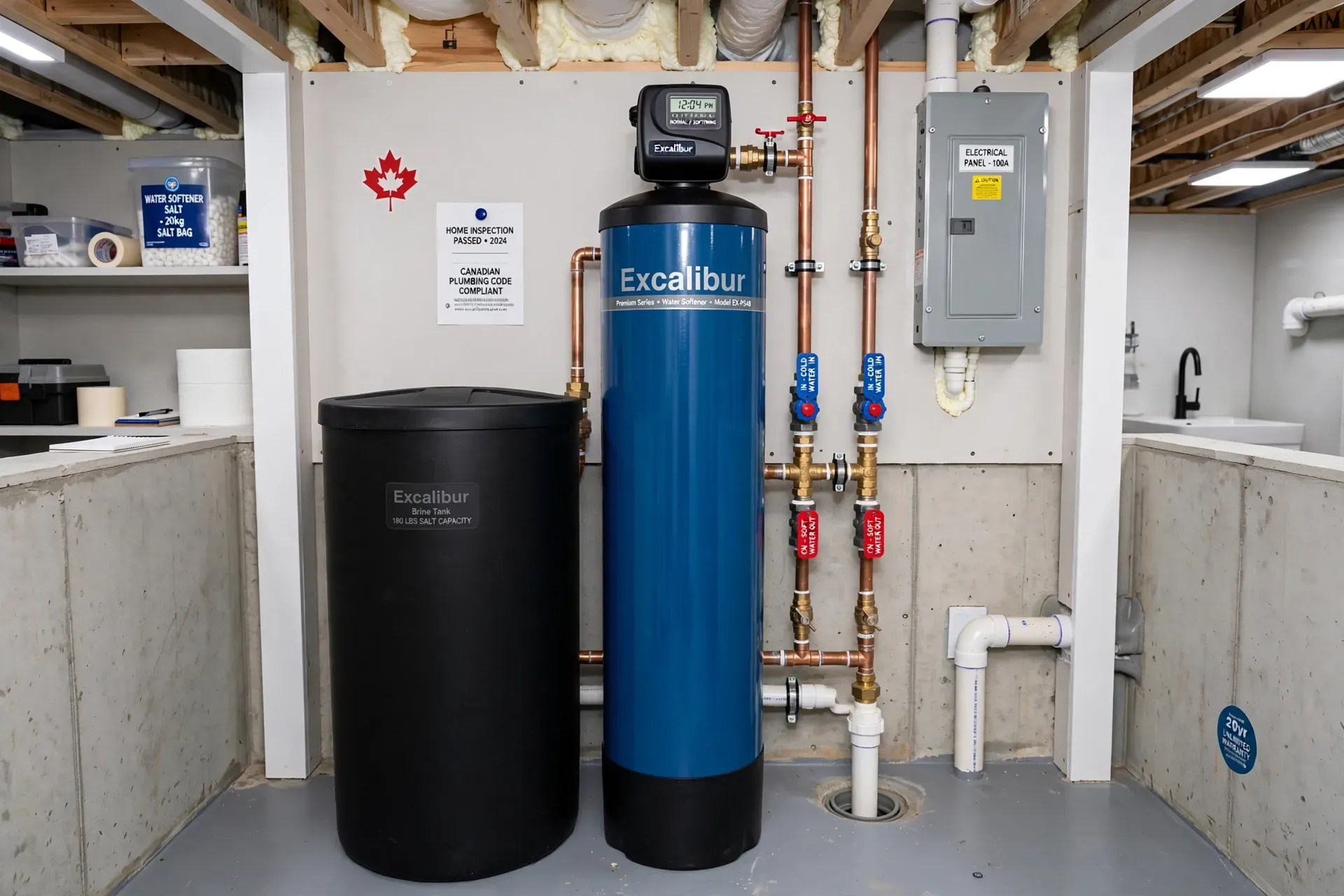
A traditional salt-based water softener solves the hard water problem using a process called ion exchange:
- Mineral Capture: Hard water enters the softener tank, which is filled with thousands of tiny resin beads coated in sodium (or potassium) ions.
- Ion Exchange: Because calcium and magnesium minerals carry a stronger positive charge than sodium, they stick to the resin beads as water passes through, displacing the sodium ions into the water.
- Regeneration Cycle: Periodically, the system flushes the resin tank with a salt-brine solution from the brine tank. This washes away the accumulated calcium and magnesium down the drain and recharges the beads with sodium.
The result is softened water delivered throughout your home, protecting your plumbing, water heater, and appliances.
Salt-Based vs. Salt-Free Systems: What to Know
When exploring water treatment options in Durham Region, you'll generally encounter two main types of systems:
1. Salt-Based Ion Exchange Softeners
- How It Works: Removes calcium and magnesium minerals completely from the water supply.
- Best For: Homes with moderate-to-high water hardness looking for true soft water benefits (lathering soap, spot-free dishes, soft laundry, and total equipment protection).
- Maintenance: Requires periodically adding water softener salt bags to the brine tank.
2. Salt-Free Water Conditioners (Tac / Template Assisted Crystallization)
- How It Works: Does not remove minerals; instead, it alters their chemical structure so they don't stick to pipes and surfaces as scale.
- Best For: Households on salt-restricted diets, eco-conscious homes wanting to avoid salt discharge, or areas with limited space for brine tanks.
- Maintenance: No salt to buy or load, though sediment filters still require routine replacement.
Is a Water Softener Worth the Investment?
For most homeowners in Whitby, Oshawa, and the surrounding Durham Region, installing a water softener pays for itself over time through lower utility costs and extended appliance lifespans.
Benefits include:
- Extended Appliance Lifespan: Protects tankless water heaters, boilers, washing machines, and dishwashers from costly scale damage.
- Lower Heating Costs: Keeps heat exchangers clean, maintaining maximum fuel efficiency for hot water systems.
- Reduced Soap & Chemical Usage: Soft water requires up to 50% less soap, detergent, and cleaning chemicals to achieve the same result.
- Easier Cleaning: Spend less time scrubbing soap scum and mineral buildup off glass doors and chrome fixtures.
Talking to Walchuk About Water Treatment
Protecting your home’s heating and plumbing systems goes beyond standard maintenance—it starts with the quality of the water running through them. Whether you are installing a new high-efficiency tankless system or looking to shield your existing plumbing from mineral scale, integrating proper water treatment is one of the smartest investments you can make.
At Walchuk Heating & Cooling, we help homeowners across Whitby, Oshawa, Ajax, and Durham Region evaluate their water quality and HVAC equipment needs. Beyond heating and cooling, we offer solutions that keep your home running smoothly, from equipment protection to total home comfort covered on our /indoor-air-quality-in-durham-region and /water-quality service pages.
Ready to test your water hardness or explore your options? Reach out to our expert team today on our /contact page or call us directly at 905-622-5435 to schedule a consultation