Considering a tankless water heater for your Durham Region home? Walchuk Heating & Cooling explains the costs, benefits, and hard water considerations before you decide.
Tankless Water Heaters in Durham Region: What Homeowners Need to Know Before Buying
As traditional storage tank water heaters reach the end of their typical lifespan, many Durham Region homeowners are evaluating their replacement options. Over the past few years, switching to a high-efficiency tankless water heater in Durham Region has become one of the most popular home upgrades.
Whether you are looking to free up floor space in your basement or eliminate the frustration of running out of hot water during back-to-back showers, converting to an on-demand system is a major decision. Here is what you need to know about performance, pricing, local water conditions, and installation requirements before making a purchase.
How Tankless Water Heaters Work
Unlike standard storage tanks that continually heat and re-heat 40 to 60 gallons of water 24 hours a day, a tankless unit operates strictly on demand.
When you turn on a hot water faucet anywhere in your home, cold water flows into the tankless unit. A flow sensor detects the demand and immediately triggers powerful gas burners or electrical elements. The water passes through a high-efficiency heat exchanger, reaching your desired temperature in seconds. As soon as you turn off the tap, the system shuts down. This process completely eliminates standby heat loss—the energy wasted keeping a massive tank of water hot while nobody is using it.
Tankless vs. Traditional Tank: A Straightforward Comparison
When evaluating a tankless vs. tank water heater in Ontario, understanding the fundamental differences helps determine which system fits your household's budget and daily needs:
- Hot Water Supply: Tank units store a finite amount of hot water. Once depleted, you must wait 30 to 60 minutes for the tank to recover. Tankless systems deliver continuous on-demand hot water in Oshawa and across Durham Region as long as the demand stays within the unit's flow capacity.
- Lifespan: Standard storage tanks generally last between 8 and 12 years before internal corrosion increases the risk of leaks. Tankless units feature modular, replaceable parts and typically last 15 to 20 years or more with routine maintenance.
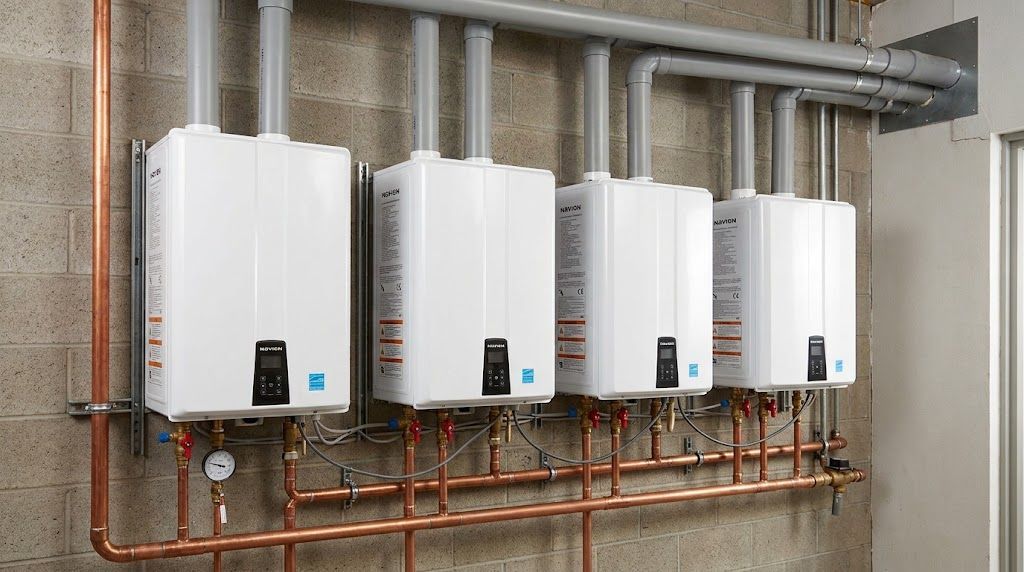
- Physical Footprint: Storage tanks occupy significant floor space in your utility room. A tankless unit is compact and wall-mounted, taking up about the size of a small suitcase.
Energy Efficiency and Long-Term Operating Costs
While on-demand water heating offers notable efficiency, it is important to balance energy savings against upfront costs.
In Ontario, the total installed cost for a professional tankless water heater conversion commonly ranges from $3,900 to $6,500, depending on the unit's capacity, fuel source, and the complexity of the venting and gas line modifications required. By comparison, replacing a standard tank heater is significantly less expensive upfront.
However, tankless systems can be up to 24% to 34% more energy-efficient than traditional storage tank heaters for homes that use 40 gallons or less of hot water daily. For busy households with higher water consumption, long-term operational savings can help offset the initial investment.
How Hard Water Affects Tankless Performance in Durham Region
One critical factor specific to our local area is water hardness. Municipal and well water across Durham Region frequently ranges from moderately hard to hard.
Hard water contains elevated levels of dissolved minerals, primarily calcium and magnesium. Because tankless heat exchangers operate at very high temperatures, these minerals quickly precipitate out of the water and form scale buildup on the internal heating surfaces.
Over time, mineral scaling creates several issues:
- Reduces thermal transfer, making the unit burn more fuel to reach temperature.
- Restricts water flow through the narrow heat exchanger channels.
- Triggers error codes or leads to premature heat exchanger failure.
Protecting Your System
To maintain optimal efficiency, tankless manufacturers require regular flushing (preventative maintenance). An annual professional descaling service typically costs between $180 and $300. Installing a whole-home water softener can dramatically reduce scale accumulation, extending service intervals and protecting your heating equipment.
Explore our solutions for mineral management on our Water Quality page.
Sizing Your Tankless Water Heater Correctly
Sizing a tankless water heater isn't based on volume; it is based on Flow Rate (GPM) and Temperature Rise. This calculation is especially critical in Canadian climates.
- Flow Rate (GPM): The total gallons per minute required if multiple fixtures run simultaneously (e.g., running a shower at 2.0 GPM and a dishwasher at 1.5 GPM requires a total flow rate of 3.5 GPM).
- Temperature Rise: The difference between the incoming groundwater temperature and your desired output temperature (usually 120°F).
In Ontario, winter groundwater temperatures can drop as low as 37°F to 40°F (3°C to 4°C). To raise 40°F incoming water to a comfortable 120°F, your system must achieve an 80°F temperature rise. Proper sizing by a licensed technician ensures your system delivers warm water consistently even during the coldest winter months.
What Installation Typically Involves
Upgrading from a tank to a tankless unit is not a simple direct swap. A professional water heater installation in Whitby, Ajax, or surrounding communities usually involves:
- Gas Line Upgrades: Tankless units require a high peak BTU input to heat water instantly, often requiring an upgrade to a larger 3/4-inch gas line.
- Direct Venting: Modern condensing tankless units exhaust cooler flue gases that require dedicated, corrosion-resistant PVC, CPVC, or polypropylene venting through an exterior side wall.
- Electrical Connection: A dedicated 120V electrical outlet is needed to power the system's electronic controls, ignition, and internal freeze-protection heating elements.
Is a Tankless Water Heater the Right Choice for Your Home?
A tankless water heater is an excellent investment if you plan to stay in your home long-term, want to free up basement space, or frequently run out of hot water with a standard tank. If you prefer lower upfront costs or have very low hot water demands, a traditional tank or high-efficiency hybrid option may still be a practical choice.
At Walchuk Heating & Cooling, our TSSA-licensed technicians can assess your home's gas supply, water hardness, and peak hot water demand to help you select the ideal system.
Learn more about our complete hydronic solutions on our Boilers & Tankless service page.
Ready to upgrade your home's hot water system? Request a free estimate today to speak with our local installation experts.